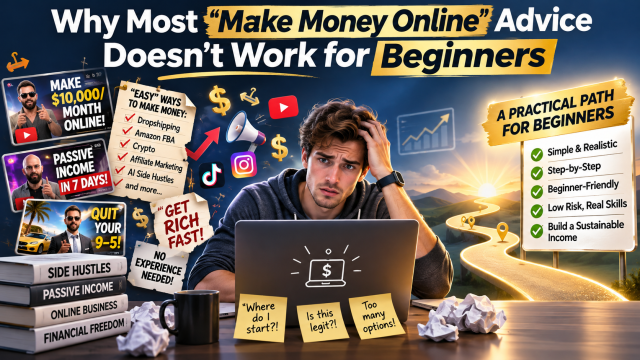
How to Pick Your First Income Path: eCommerce, Services, or Content

In 2019 I spent four months building a dropshipping store selling bamboo kitchenware. I picked it because a YouTube video told me kitchen products were “evergreen” and “high margin.” I had never cooked anything more complicated than pasta and I had eleven hours a week to spend on the business, most of it after 9pm. The store made two sales before I shut it down. The problem was never the product. The problem was that I chose a business model based on what looked exciting instead of what matched my actual week.
That mistake cost me more than the money I spent on ads. It cost me four months I could have spent on something that actually fit my life. If you’re trying to figure out how to choose a side hustle right now, the single biggest thing I’d change about my own path is this: decide based on your hours and your existing skills first, and worry about which model is “best” a distant second.
Key Takeaways
- The right first income path depends on how many consistent hours you have each week and what skills you already have, not on which model has the highest earning ceiling.
- eCommerce rewards people with more upfront time and some tolerance for spending money before they make any, while services reward people who need income faster but have fewer free hours.
- Content creation is the slowest of the three to pay off but asks the least in upfront cash, which makes it a reasonable fit if your time is irregular rather than scarce.
- AI-assisted tools have changed the hours math for all three paths, but they don’t remove the need to pick the model that matches your actual week, not your ideal one.
Why “which is best” is the wrong question
Every one of these three paths, eCommerce, services, and content, has someone online telling you it’s the best option. Search for any of them and you’ll find a confident person with a confident thumbnail telling you the other two are a waste of time. I’ve read dozens of these. They’re not lying exactly, they’re just answering a different question than the one you’re asking. They’re answering “what worked for me,” not “what will work for you.”
Here’s what actually determines whether a side hustle works: whether you can keep showing up to it for the first three to six months before it pays you anything meaningful. That’s it. Not the margin, not the market size, not whether it’s trendy. If the model you pick doesn’t fit the hours you actually have and the skills you actually bring, you’ll stop before it has a chance to work, the same way I stopped with the bamboo kitchenware store.
So instead of asking which path is best, ask two questions: how many real hours do you have each week, and what do you already know how to do that other people would pay for or want to watch? Your answers to those two questions will point you toward one of the three paths far more reliably than any ranking article.
Start with your hours, not your ambition
Be honest about this part. Not the hours you’d have in a perfect week where nothing goes wrong, the hours you actually have on a normal Tuesday after the kids are in bed or the ones you can protect on a Saturday morning before the rest of the day gets away from you.
When I was running that failed store, I told myself I had fifteen hours a week. The truth, when I actually tracked it for two weeks, was closer to six. Three of those evenings I was too tired to do more than scroll supplier listings without really evaluating them. That gap between fifteen imagined hours and six real ones is why the business never got proper attention. I wasn’t lazy. I was planning around a week I didn’t have.
Try this before you choose anything: track your actual free time for one week using your phone’s screen time log or just a notes app, writing down every evening and weekend block you had free and what you did with it. Most people are surprised by the number, usually lower than they guessed. Once you have a real number, match it against what each path typically demands in its first few months:
- Under 5 hours a week: content creation is the only one of the three that can move forward in small, disconnected chunks. A 20-minute writing session or filming one short video on a Tuesday night still counts as progress.
- 5 to 10 hours a week: services work well here because the hours translate almost directly into client work and income, even if progress is slow.
- 10 hours a week or more, in longer blocks: eCommerce becomes realistic, because sourcing products, setting up a store, and testing ads takes sustained focus rather than five-minute fragments.
None of this is a rigid rule. It’s a starting filter to stop you doing what I did, picking a model that needs ten focused hours a week when you actually have six scattered ones.
Then look at what you already know
Hours tell you how much time you have. Skills tell you how fast you can start making progress inside that time, which matters just as much when you’re choosing between the three paths.
If you’ve spent five years doing bookkeeping, customer support, graphic design, copywriting, project management, or anything else someone pays you a salary for right now, you already have the raw material for a services business. You don’t need to invent a skill from nothing. You need to package the one you have into something a stranger can hire you for. This is the fastest of the three paths to a first dollar, because you’re selling something you can already do today, not something you have to learn how to do first.
If you have an eye for what sells, patience for research, and some comfort with spreadsheets and basic numbers, eCommerce fits better. You don’t need to be a designer or a marketer starting out, but you do need to be willing to sit with supplier comparisons, margin calculations, and ad performance numbers without your eyes glazing over. If spreadsheets make you want to close the laptop, that’s useful information, not a character flaw. It just means this path will feel like a longer slog for you than it would for someone who enjoys that part.
If you have a point of view on something, a hobby you can talk about for twenty minutes without notes, or a knack for explaining things clearly, content creation fits. This path rewards people who already talk about their topic unprompted, to friends, in group chats, wherever. If you find yourself explaining the same thing to different people over and over because you find it interesting, that’s a signal worth paying attention to.
Here’s the honest trade-off nobody puts in the thumbnail: services pay fastest but cap your time, since you’re trading hours for money just like your job does. eCommerce can scale past your personal hours but asks you to spend money before you’ve made any, and that money isn’t guaranteed back. Content creation asks for almost no money but the most patience, since audiences build slowly and monetization usually lags behind the audience by months.
A simple way to decide, in order
If you’re still stuck, work through these four questions in order. Each one narrows the field. By the end you’ll usually have a clear front-runner, not a perfect answer, but a reasonable place to start.
- How many real hours do you have each week, tracked, not guessed? This sets your ceiling before you even think about skills.
- Do you have a marketable skill you could sell as a service this month, with no new training? If yes, and your hours are limited, services deserves serious weight.
- Can you afford to spend money for a few months with no return, not money you need for rent, just money you can lose without it hurting? If no, that mostly rules out eCommerce for now, since inventory, samples, and ad testing all cost money before they make any.
- Do you already talk, write, or post about one topic more than your friends find normal? If yes, and you answered no to the money question above, content creation is worth a real trial, because it needs patience more than capital.
Run your own situation through those four. With the bamboo kitchenware store, question three would have stopped me cold. I didn’t have money to lose, I had a credit card I was hoping would turn into profit before the bill came due. That’s not spare capital, that’s borrowed optimism, and it’s a bad foundation for any business model.
Where AI actually changes the calculation
I want to be straight with you about this part, because I’ve seen plenty of people oversell it. AI tools don’t remove the fundamental trade-offs above. They don’t turn eCommerce into a zero-cost venture or make a content channel grow overnight. What they do is lower the hours cost inside each path, which matters a lot if your spare time is the scarcest resource you have.
For services, AI tools can draft client proposals, first-pass copy, or research summaries in minutes instead of the hour or two it used to take me, which means a service business that needed ten hours a week to run can sometimes run on six or seven now. For eCommerce, AI can speed up product description writing, basic customer service replies, and some of the market research that used to mean hours of manual scrolling through supplier sites. For content, it can help you get from a blank page to a workable first draft faster, though the thinking, the editing, and the parts that sound like you still take real time and real judgment.
What AI hasn’t changed is the order of operations. You still need to pick the path that fits your hours and skills first. A faster way to write client proposals doesn’t help you if you picked a model that needed fifteen hours a week when you have six. The tool speeds up the path, it doesn’t choose it for you.
What actually happens in the first month of each path
It helps to know what you’re signing up for before you start, not the highlight reel version, the actual Tuesday-night version.
With services, your first month usually looks like this: you write a simple offer describing exactly what you do and for whom, you reach out to five to ten people directly rather than waiting for them to find you, and if you’re lucky one of them says yes to a small paid project. The hard part isn’t the work itself, it’s the reaching out, because asking someone to pay you for something feels uncomfortable the first dozen times you do it. It gets easier. It doesn’t get easy immediately, and anyone who tells you otherwise is skipping the part that actually matters.
With eCommerce, your first month usually looks like choosing a narrow product category, finding two or three potential suppliers, ordering samples, and building a simple store, often with more hours going into research and comparison than into anything that looks like “running a business.” You likely won’t have made a sale by day 30. That’s normal, not a sign of failure, but it’s also exactly the stage where people panic and quit, so expect it going in.
With content, your first month usually looks like publishing something, a short video, a written post, a handful of social posts, and almost nobody seeing it. The audience, if it comes, comes slowly and unevenly. Some weeks nothing happens, then one piece gets more attention than the rest for reasons you can’t fully explain. The skill you’re building in month one isn’t audience size, it’s the habit of publishing consistently even when the feedback is quiet.
Knowing this in advance doesn’t make any of it more comfortable. It does mean you won’t mistake the normal early stage of a working path for a sign you picked the wrong one.
The mistake I see most often
The most common version of my bamboo kitchenware mistake isn’t picking the wrong model exactly. It’s picking a model based on someone else’s story instead of your own numbers. You watch someone describe how eCommerce changed their life, and you don’t ask whether they had twenty hours a week and savings to risk when they started, which they probably did and never mentioned. You watch a content creator with half a million followers and don’t account for the eighteen months before anyone was watching.
The fix isn’t to ignore other people’s stories. It’s to notice the parts they leave out, the starting hours, the starting money, the starting skills, and compare those to your own before you borrow their path. My bamboo store failure wasn’t really about kitchenware. It was about copying a model built for someone with more time and more risk tolerance than I had, without checking whether it fit me first.
Once I started asking the hours-and-skills question honestly, instead of the which-is-hottest question, the path I landed on looked less exciting on paper and worked a lot better in practice. That’s usually how it goes. The realistic choice rarely makes a good headline. It just makes progress.
Picking is only the first step
Choosing the right path gets you out of the starting-line paralysis, but it doesn’t remove the work of building something inside that path. The decision above narrows three options down to one. What you do in the weeks after that decision, how you structure your limited hours, how you use AI tools to close the gap between what you know and what you need to do, is where the actual progress happens.
That’s the part most “make money online” content skips entirely, because the decision is the easy, exciting bit and the execution is the slow, unglamorous bit that actually matters. If you want a structured way to move from picking a path to actually working it, without the overwhelm of fifty open browser tabs and conflicting advice, that’s what I built the guide at find out more to walk you through.
Frequently Asked Questions
How do I know if I have enough time for a side hustle?
Track your actual free evenings and weekend hours for one week using a notes app or your phone’s screen time log, rather than guessing. Most people overestimate by a wide margin, the same way I thought I had fifteen hours a week when I really had six. Once you have a real number, match it against the hours each path typically needs in its first few months, as outlined earlier in this article.
Can I start a side hustle with no money at all?
Content creation and most service businesses can start with little to no upfront cash, since you’re selling time, skill, or attention rather than physical products. eCommerce almost always needs some money for samples, inventory, or testing, even a modest amount, so if you genuinely have none to risk, that path should wait until you’ve built some from one of the other two.
Which side hustle makes money the fastest?
Services usually produce a first payment the fastest, often within a few weeks, because you’re selling a skill you already have to someone who needs it now. eCommerce and content creation both typically take longer before any income shows up, since they involve building something, a store or an audience, before a transaction happens.
Is it better to pick one side hustle and stick with it, or try a few?
Pick one and give it a real trial of a few months before judging it, because switching too early is often what stops progress rather than a wrong choice itself. If after a genuine, consistent effort it clearly doesn’t fit your hours or skills the way you expected, it’s reasonable to reassess, but that decision should come after real effort, not after one quiet week.