How to Set Up Your First AI-Assisted Workflow This Weekend
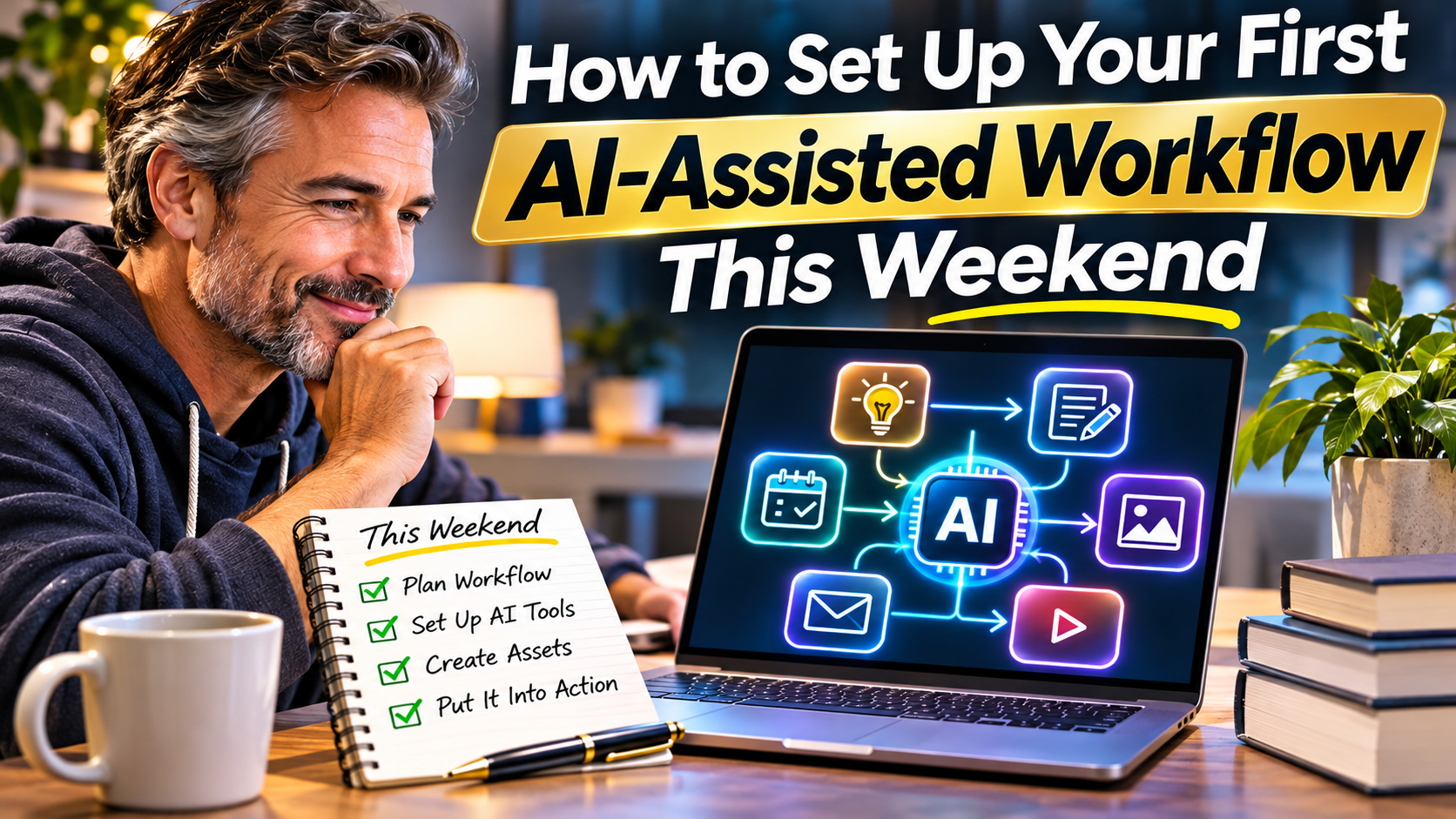
On a Saturday morning in October, I sat down with a coffee, a notebook, and three browser tabs open, determined to finally build something that didn’t fall apart by Wednesday. Two hours later I had a working system: a content calendar, a prompt I could reuse, and a process for turning one hour of input into three pieces of usable output. It wasn’t fancy. It wasn’t finished. But it worked, and it kept working the next week, and the week after that. That’s the whole goal of an ai workflow for side hustle: not perfection, just something that survives contact with a Tuesday.
Most people never get there because they try to build the whole machine before they’ve tested one part of it. This is the walkthrough I wish someone had handed me instead of the forty-tab research spiral I put myself through for the better part of two years.
Key Takeaways
- You can build a working first version of an ai workflow for side hustle in one focused weekend session of two to three hours, not a week of research.
- The goal isn’t a perfect system, it’s one that survives your actual schedule and gets used again the following week.
- Pick one narrow task to automate first, like turning research into a draft or batching product descriptions, rather than trying to systemize your whole hustle at once.
- Write down your process in plain steps as you go, because that document becomes the thing you improve later instead of starting over from scratch.
Why most side hustle systems die in week two
I used to think my problem was motivation. It wasn’t. I’d start a side hustle, usually something content-related, with a burst of energy on a Sunday. I’d write three posts, set up a spreadsheet, maybe even batch some graphics. Then Monday hit, work got loud, and by the following weekend I had no idea what I’d done or why. I’d open the spreadsheet and feel exhausted just looking at it.
The system wasn’t the problem. The size of the system was. I was building something that needed two hours a day to maintain, when I had maybe four hours a week, total, and some weeks less than that.
An ai workflow for side hustle fixes this a different way than most people expect. It’s not about AI doing the work for you so you do nothing. It’s about AI collapsing a four-step task into a two-step task, so the version of you with forty-five minutes on a Tuesday night can actually keep it running. That’s the test every piece of this weekend build has to pass: can tired-Tuesday-you still do this?
Before Saturday: pick one output, not five
The biggest mistake I made early on was trying to build a system for “my side hustle” as a whole. That’s too big a target. You can’t build a workflow for a vague noun. You can build a workflow for one repeatable output.
Pick one of these, based on what you’re actually doing:
- Turning a topic into a finished blog post or newsletter.
- Turning a product photo and a few bullet points into a full listing description.
- Turning a client call recording into a proposal draft.
- Turning one piece of long content into five short social posts.
Notice the shape of each one: input on the left, finished thing on the right. That’s what a workflow is. If you can’t describe your task that way yet, spend fifteen minutes before Saturday writing down what the input is and what the finished output should look like. Everything else gets built around that sentence.
When I did this the first time, my sentence was: “Turn a rough idea and three bullet points into a 600-word draft I can edit in under twenty minutes.” That one sentence did more work than three months of browsing tool comparison lists ever did.
Hour one: map the manual version first
Before you touch any AI tool, write out how you’d do this task with zero automation. Every single step. This feels backwards, I know. You’re trying to save time and I’m telling you to spend thirty minutes mapping the slow version. Do it anyway.
Here’s mine, from that October morning, for turning an idea into a draft:
- Think of a topic based on a question I keep getting asked or a problem I just solved myself.
- Jot down three to five points I want to make, in no particular order.
- Write a rough outline with a beginning, middle, end.
- Write a full first draft, badly.
- Edit the draft for clarity and cut the parts that drag.
Five steps. Doing all five by hand used to take me two to three hours per piece, which is exactly why I only ever managed one post every couple of weeks before I burned out on the whole idea.
Once you have your five or six manual steps written down, look at them and ask one question for each: does this step require my judgment, or is it mechanical? Step one and step five in my list need me. I’m the one who knows what my audience actually asks and I’m the one who can tell if a sentence sounds like me. Steps two through four are mechanical enough that a tool can take the first pass.
That’s the whole trick behind every useful ai workflow for side hustle. You’re not removing yourself from the process. You’re removing yourself from the parts where your judgment wasn’t adding much anyway, and keeping yourself fully in the parts where it is.
Hour two: build the three-step loop
Now take your mechanical steps and turn them into one prompt-driven loop. This is where people overcomplicate things, so I’ll give you the version that actually held up for me, stripped down to three parts.
Step 1: The brief
Write a short, specific prompt that describes your output, your audience, and your constraints. Not a vague “write me a blog post about X.” Something closer to what I actually used:
“I run a blog for people trying to build a side income around a full-time job. Write a 600-word draft on [topic]. Use a direct, plain-English tone, no hype, include one honest example of something that didn’t work before it worked. Structure: short opening, a section on the mistake, a section on the fix, a short close. Don’t use the phrase ‘game changing’ or anything like it.”
Notice how much is in there: audience, tone, length, structure, and what to avoid. The first few times I used AI tools I gave them almost none of this, got generic mush back, and decided the tools “didn’t work for my niche.” They worked fine. My brief was the problem.
Step 2: The draft
Run the brief, get a draft back. It will not be done. It will not sound fully like you. That’s fine, because this draft isn’t the product, it’s the clay. Your job in this step is purely to generate raw material fast, which is the one thing these tools are genuinely good at.
Step 3: The pass
This is the step people skip, and it’s the one that matters most. Read the draft and do three things: cut anything that sounds like it could apply to any business in any industry, add one detail only you would know, and read it out loud to check it sounds like a person talking, not a brochure. This pass took me about fifteen minutes once I got used to it, down from the forty-five it took the first week.
Three steps. Brief, draft, pass. Write this loop down somewhere you’ll actually see it again, a sticky note, a note on your phone, the top of your spreadsheet. The document matters more than it sounds like it should, because next weekend you won’t remember the exact wording that worked, and re-deriving it from scratch is how systems quietly die.
What this looks like for eCommerce instead of content
If you’re selling physical or digital products rather than writing, the loop looks almost the same, just with different inputs. Say you’re listing handmade items or sourced products. Your manual version might be: take photos, measure the item, think of a title, write a description, decide on tags or categories.
The mechanical middle here is the description and the tags. You still need to take the photos and know your product. But once you have five bullet points about an item, a well-built brief can turn that into three description variants in under a minute, and you pick the one closest to right and edit from there. I know someone running a small resale shop who went from spending twenty minutes per listing to about six, using exactly this three-step loop, just with product details instead of blog topics as the brief.
The shape doesn’t change. Brief, draft, pass. What changes is what goes into the brief and what “done” looks like for the pass.
What this looks like for a service business
If you’re doing freelance or service work, say bookkeeping, design, virtual assistant work, consulting, the repeatable output is usually a proposal, an onboarding email, or a recurring report. The manual version eats time because you’re rewriting the same structure every time with slightly different details.
Build one brief for your most common document. For a proposal it might include your standard scope language, your pricing structure, and the specific client’s stated problem. The draft step gives you a full proposal in the right shape. The pass step is where you insert the details only you’d know about this particular client and cut anything generic-sounding that crept in. People notice generic proposals immediately, even if they can’t say why something feels off, so this pass step is not optional here.
The part nobody warns you about: it will feel too simple
When I finished that first Saturday session, I remember feeling almost suspicious of how little I’d built. Three steps, one document, no fancy software stack, no automation platform with twelve connected apps. Surely a real system needed more than that.
It didn’t. The three-step loop I built that morning is still, in its bones, the same one I use now. What’s changed over time is the detail inside each step, not the shape. I’ve refined my briefs. I’ve gotten faster at the pass. But the simple version worked from day one, and the complicated version I’d tried to build in previous years had never worked at all, because I never finished building it before giving up.
This is worth sitting with if you’re the kind of person, like I was, who researches for months before starting anything. The research isn’t nothing, but at some point it becomes a way of avoiding the uncomfortable first attempt. A rough version running for real beats a perfect version still in planning, every time, because only the rough version teaches you anything.
Setting up the ai workflow for side hustle so it survives next weekend
A system you build once and never touch again isn’t a system, it’s a one-off. The difference between the two is whether you’ve made it easy to repeat without thinking hard about it. Here’s what made mine stick.
- I saved my brief as a template. Not retyped from memory each time, copied and adjusted. This alone cut my setup time for each new piece from ten minutes to about ninety seconds.
- I scheduled the loop, not the output. Instead of telling myself “write a post this week,” I told myself “run the loop for twenty minutes Tuesday night.” The loop is a small, specific, low-resistance action. “Write a post” is vague and easy to avoid when you’re tired.
- I tracked one number. How many times did I run the full loop this week. Not views, not income, not followers, just repetitions. Early on, consistency of the process matters more than the quality of any single result, because the process is what compounds.
- I let the first few outputs be mediocre on purpose. I wasn’t trying to publish my best work in week one. I was trying to prove the loop could run twice in a row without me abandoning it. That’s a different goal, and it’s the one that actually matters at this stage.
None of this took special software. I used a basic AI chat tool, a plain document for my brief, and a simple spreadsheet with one column: date, and one column: did I run the loop. That’s it. The system doesn’t need to be impressive to work. It needs to survive being used by a tired person on a weeknight.
Common ways this goes wrong in week two
I’ve watched enough people try this, and made enough of these mistakes myself, to know where it usually breaks.
The first failure point is rewriting the brief every single time instead of reusing and adjusting it. If you’re starting from a blank page with the AI tool each session, you haven’t actually built a workflow, you’ve just found a slightly faster way to do the same unstructured thing. The brief needs to live somewhere permanent.
The second is skipping the pass step because the draft “looked good enough.” This is the step that keeps your output sounding like you and not like a template. Skip it a few times and your content starts to feel hollow, even to you, and that feeling is usually what kills motivation faster than lack of time does.
The third, and the one that got me for years before AI entered the picture at all, is trying to scale the system before you’ve run it consistently at small scale. Don’t try to publish five pieces a week once you’ve proven the loop works for one. Prove it holds for three or four weeks running one output, then think about adding a second one. Adding complexity before you have consistency is how the two-hour Saturday project turns back into the thing you abandon by Wednesday.
What a realistic first month looks like
I won’t tell you a number, because yours will depend on what you’re building and how many hours you genuinely have, and anyone who gives you a specific income figure after one weekend is selling you something, not helping you. What I can tell you is the shape of a realistic first month, because that shape held for me and for most people I’ve talked to who built this way instead of chasing a shortcut.
Week one, you build the loop and it feels clunky. The brief needs rewording. The pass step takes longer than it should. That’s normal, not a sign of failure.
Week two, you run it again and it’s noticeably faster. You start recognizing patterns in what the draft step gets wrong, so your pass step gets more targeted.
Week three, the loop starts feeling almost boring, in a good way. Boring means it’s become routine instead of a decision you have to psych yourself up for each time.
Week four, you have a small, un-flashy body of consistent output, and probably some early sense of whether this direction is worth continuing or whether you need to adjust the output you picked back in step one. Either answer is useful. The point of the weekend build was never to guarantee the direction was right, it was to get you moving fast enough to find out.
If you’re starting completely from zero
If you don’t have a side hustle running yet and you’re building one from nothing, everything above still applies, you just need to pick your one output before Saturday rather than during it. Spend one evening this week deciding: content, products, or services, and one specific recurring thing you’ll produce. Don’t try to decide the whole business model in that evening. Decide the one output.
Then follow the same two-hour build: map the manual version, find the mechanical middle, build the three-step loop, save the brief. The weekend build doesn’t care whether you’re six months into a side hustle or six hours into deciding to start one. The shape of the system is the same either way.
If you want a more structured walk through turning this kind of overwhelm into an actual plan you can follow step by step, that’s exactly what I put together at find out more, based on what actually got me unstuck after a few years of false starts.
Frequently Asked Questions
Do I need to pay for AI tools to build this workflow?
No. Most widely available AI chat tools have a free tier that’s more than capable of running the brief, draft, pass loop described here. You can always upgrade later if you find yourself hitting usage limits, but don’t let a subscription decision delay your first weekend build.
How much time does this actually take to maintain each week, after the first weekend?
Once the loop is built, most people spend between twenty and forty-five minutes per output, depending on how much editing the pass step needs. That’s a rough range based on what it took me and others I’ve talked to, not a promise, since your topic and your editing speed will shift the number.
What if the AI draft sounds nothing like me?
That’s normal for the first few attempts, and it’s exactly what the pass step is for. The fix is usually a better brief, with more specific instructions about tone and at least one real example included directly in the prompt, rather than giving up on the tool entirely.
Should I build workflows for multiple parts of my side hustle at once?
Not at first. Build and run one loop consistently for three or four weeks before adding a second. Trying to systemize everything in one weekend is the most common reason people abandon the whole approach by week two.
If this weekend build gets you moving, the next useful step is turning that momentum into a fuller plan rather than letting it fade once the novelty wears off, which is where find out more comes in.