AI-Assisted Side Hustles Explained in Plain English

In 2021 I spent eleven nights in a row writing product descriptions for an online store that sold exactly four items. I was doing the work of a full marketing team by myself, at 10pm, after a full day job, and the store still made less than my electricity bill. Three years later I run a much smaller operation, spend about six hours a week on it, and it actually turns a profit. The difference wasn’t luck or a sudden burst of talent. It was figuring out what “AI-assisted” really means for someone with no team, no budget, and no spare hours to waste.
This article is the plain-English version of that shift. No jargon, no theatrics, just what changed and why it mattered.
Key Takeaways
- “AI-assisted” simply means using AI tools to do the repetitive, time-consuming parts of a side hustle so you can spend your limited hours on the decisions only you can make.
- AI doesn’t replace the need for a real offer, a real audience, or real follow-through, it just removes the bottleneck that used to stop people with day jobs from ever finishing the work.
- The biggest mistake people make is using AI to produce more content or products faster, instead of using it to free up time for the strategy and judgment that actually drives income.
- You can test this approach in a few hours a week without quitting anything or spending money on tools you don’t understand yet.
What “AI-Assisted” Actually Means (Not the Hype Version)
Somewhere along the way, “AI-assisted side hustle” started sounding like a magic phrase, like you type a sentence into a chatbot and a business appears. That’s not what happened to me, and it’s not what happens to anyone who’s being honest about it.
Here’s the plain version. An AI-assisted side hustle is one where you use AI tools to handle the mechanical, repetitive parts of running a small business or project, so the few hours you have left go toward the parts that actually require a human. Writing fifty product descriptions is mechanical. Deciding which ten products are worth selling is not. Drafting a first version of a client proposal is mechanical. Deciding what that client actually needs and whether you want to work with them is not.
When I was grinding through those eleven nights in 2021, I was spending almost all of my time on the mechanical part. I’d research a product, write a description, format it, write three social captions about it, then do it again for the next product. None of that required me specifically. A tool could have done eighty percent of it in a fraction of the time, if I’d known how to use one, or trusted it enough to try.
That’s the whole shift. Not “AI runs your business,” but “AI absorbs the repetitive labor so your actual hours go further.” If you’ve got five hours a week after work and the kids and dinner, that distinction is the entire ballgame.
The Years Before AI: What I Was Actually Doing Wrong
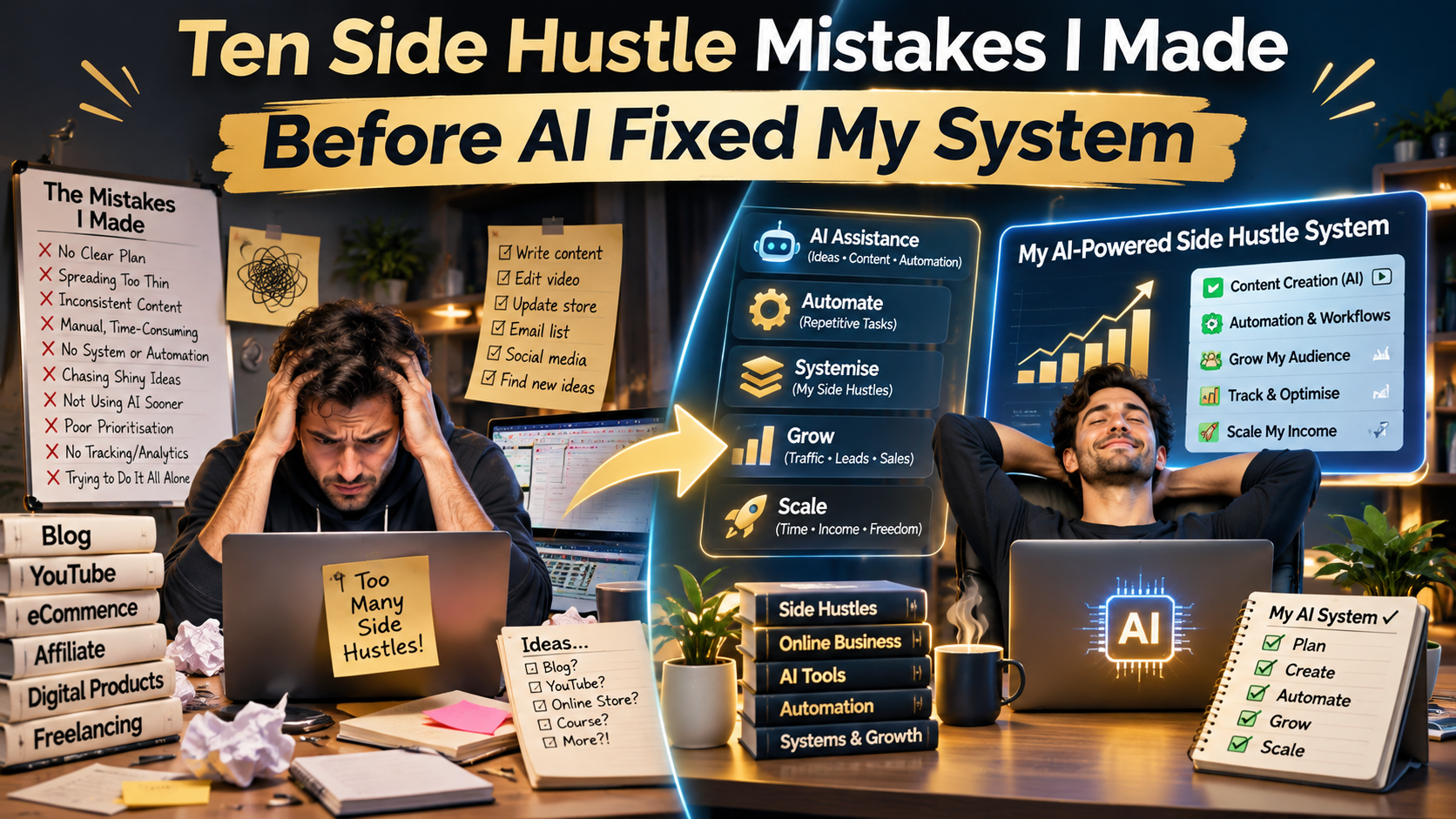
I want to be specific here, because vague stories about “struggling” don’t help anyone. Between 2018 and 2021 I tried three different things: a dropshipping store, a freelance writing side gig, and a small YouTube channel about budgeting. All three failed to go anywhere, and all three failed for the same underlying reason.
The dropshipping store died because I spent all my evening hours on product listings and none on actually understanding who’d buy the stuff. I had forty products listed and zero idea who my customer was. The freelance writing gig stalled because every proposal took me ninety minutes to write from scratch, so I could only pitch two or three clients a week, which meant maybe one reply, which meant I gave up after six weeks. The YouTube channel never got past video four because editing one ten-minute video took me five hours, and five hours a week was my entire side hustle budget, gone on editing alone.
In every case, the bottleneck was the same: too much of my limited time went into production, and not enough went into the thinking that would have made the production worth doing. I wasn’t lazy. I wasn’t untalented. I was just spending my scarcest resource, time, on the wrong eighty percent of the work.
This is the part most “side hustle” advice skips. It tells you to pick a niche, build an offer, find your audience, like those are three quick checkboxes. Nobody mentions that doing the actual production work around a full-time job eats every hour you’d need for the strategic thinking that makes the offer good in the first place.
What Changed: A Concrete Walkthrough
By 2022 I’d mostly given up on the idea that I had enough time for a side hustle. Then I started using AI tools, not because I believed the hype, but because a friend showed me how she used one to draft client emails in a fraction of the time it used to take her. I was skeptical. I tried it anyway, because I had nothing left to lose and about forty minutes free one Tuesday night.
Here’s what that forty minutes actually looked like, because I think the specifics matter more than the summary. I had a small freelance editing side gig at the time, three clients, inconsistent work. I used an AI writing tool to draft the first version of a pitch email to five potential new clients. Instead of the ninety minutes per proposal I mentioned earlier, I had five rough drafts in about fifteen minutes. Then I spent the remaining twenty-five minutes doing the part that actually mattered: reading each draft, cutting the generic bits, adding something specific about that client’s actual business, and making sure the offer matched what they seemed to need.
Two of those five replied. One became a client. That one client was worth more than the six weeks of effort I’d put into my 2019 freelance attempt, because this time my hours went into tailoring and judgment instead of blank-page typing.
That’s the pattern that repeated everywhere I applied it after that. AI handled the first draft, the repetitive structure, the rough version. I handled the editing, the judgment calls, the specific knowledge of my own audience or clients that no tool has. The combination is what worked. Neither half worked alone. A tool with no human judgment behind it produces generic, forgettable output. A human with no tool spends all their hours on the blank page and runs out of time before the judgment ever gets applied.
Where AI Actually Helps in a Realistic Side Hustle
Let me get specific about where this applies, because “AI helps with content” is the kind of vague claim that doesn’t actually tell you anything.
For eCommerce
If you’re running a small store, AI tools are genuinely useful for drafting product descriptions, generating variations of ad copy to test, and summarizing customer reviews to spot patterns you’d otherwise miss scrolling through forty reviews at midnight. What they’re not good for is picking your product line or understanding your actual margins. I learned that the expensive way, running products that looked great in a generated description and sold terribly because nobody wanted them at that price point.
For Services
This is where I’ve had the most consistent results. Drafting proposals, writing first-pass client emails, summarizing a long client brief into three clear action points, structuring a contract outline. All mechanical, all repetitive, all things that used to eat my evenings. The client relationship itself, the pricing conversation, the judgment about whether a project’s a good fit, still needs you.
For Content Creation
Outlining, generating a first draft, suggesting title variations, repurposing one piece of content into three shorter versions for different platforms. What AI won’t do is know what your actual audience cares about, or bring the lived experience that makes a piece of content worth reading instead of skimmable filler. The YouTube channel I abandoned in 2019 would still have failed with AI editing tools, because the problem wasn’t editing speed, it was that I hadn’t figured out who I was making videos for.
Notice the pattern across all three. AI explained in plain terms is this: it does the first draft and the repetitive structure, you do the parts that require actually knowing your business, your audience, or your client. Any version of “AI-assisted side hustle” that skips that second half is selling you half a system.
The Mistake Almost Everyone Makes With This
Here’s the part that cost me about four months of wasted effort before I understood it properly. When I first started using AI tools, I used the extra time I’d freed up to produce more. More product listings. More blog drafts. More social posts. It felt productive. Volume went up. Results didn’t.
The mistake was obvious in hindsight: I was using AI to do more of the same mechanical work faster, instead of using the time I’d saved to do more of the thinking that actually moves a side hustle forward. More listings for products nobody wanted. More blog drafts for a topic with no clear audience. More social posts with no strategy behind them.
The fix wasn’t a better tool. It was a different decision about where my freed-up hours went. Instead of writing twelve product descriptions in the time it used to take to write three, I wrote three descriptions and spent the rest of that hour actually looking at which of my existing products were converting and why. That’s the shift that mattered. AI gave me the hours back. I still had to choose to spend them on judgment instead of volume.
If there’s one thing I’d tell someone starting this today, it’s that. The tool isn’t the bottleneck anymore once you learn to use it. Your decision about what to do with the time it frees up is the new bottleneck, and it’s a much better problem to have.
What This Looks Like With Five Hours a Week
You probably don’t have twenty hours a week for a side hustle. I didn’t either when any of this started working for me. Here’s roughly how I’d structure five hours now, compared to how I used to spend five hours in 2019.
In 2019, five hours went almost entirely into production: writing, editing, formatting, posting. Maybe four and a half hours of typing and half an hour, if I was lucky, of actually thinking about strategy.
Now, that same five hours splits roughly into two hours of AI-assisted drafting across whatever the week’s priority is, product descriptions, a client proposal, a content outline, and three hours of the work only I can do: reviewing what’s actually converting, reaching out to a specific client with something tailored to them, reading the three customer comments that tell me something real about what’s working. The ratio flipped. That flip is the entire reason the results followed.
This is also why I’m skeptical of anyone who frames AI-assisted side hustles as a way to do dramatically more volume with the same five hours. Volume was never the problem for most people stuck in this spot. Judgment time was. If you take the hours AI frees up and just produce more stuff, you’ll end up exactly where I was in 2019, just faster.
A Realistic Starting Point, Not a Leap
If you’re reading this because you’ve tried a side hustle before and it fizzled, I’d guess the fizzle point was similar to mine: you ran out of hours before you ran out of ideas. That’s not a motivation problem. It’s a hours-to-output ratio problem, and it’s fixable without quitting your job or finding six extra hours a week that don’t exist.
Start smaller than feels satisfying. Pick one repetitive task in whatever side hustle idea you’re considering, a weekly social post, a client email template, a product description format, and try using an AI tool to draft it, then spend your own time editing it into something specific and good. Don’t try to overhaul your whole approach in one weekend. The point isn’t to produce more. It’s to notice where your time actually goes once the mechanical part takes fifteen minutes instead of ninety.
What you’ll probably find, the way I did, is that you suddenly have room for the strategic thinking you never had time for before. That’s the moment an AI-assisted side hustle stops being a buzzword and starts being a working system. Not because the AI is doing the business for you. Because it finally gave you back the hours to do the business part yourself.
Why This Took Me Years to Figure Out
I’ll be honest about why this wasn’t obvious to me sooner. Most of what I read about AI tools in 2021 and early 2022 was framed around speed and volume: write a hundred blog posts in an hour, generate a thousand product descriptions overnight. That framing is technically true and almost useless for someone with a day job and a handful of hours a week. You don’t need a hundred blog posts. You need the three that actually land with the twelve people who’d pay for what you’re offering.
It took watching my own four months of wasted volume to understand that the tool wasn’t the missing piece. The missing piece was always judgment, and judgment takes time that production used to eat. AI’s real contribution, for someone in your position, isn’t that it makes you prolific. It’s that it makes you available for the thirty minutes of thinking that used to get crowded out by two hours of typing.
That reframe is the entire reason this blog exists. Not to tell you AI will build a business for you while you sleep, because it won’t, and anyone telling you that is selling something that doesn’t survive contact with reality. It’s to walk through, plainly, what actually changed when I stopped treating AI as a content factory and started treating it as a way to buy back my scarcest resource: the handful of hours I had left after work, dinner, and everything else that fills a day.
Frequently Asked Questions
What does AI-assisted side hustle actually mean?
It means using AI tools to handle the repetitive, mechanical parts of running a small business or side project, like first drafts of product descriptions, client emails, or content outlines, so your limited time goes toward the decisions and judgment calls that actually require you. It’s not AI running the business on its own.
Do I need technical skills to start an AI-assisted side hustle?
No. The tools that matter for this are built for everyday use, mostly typing a request in plain language and getting a draft back. The skill that matters more is knowing your own audience or clients well enough to edit that draft into something specific and good, which isn’t a technical skill at all.
How much time does an AI-assisted side hustle actually take per week?
It depends on what you’re building, but a realistic starting point is somewhere between three and six hours a week, especially if you’re testing an idea before committing further. The point of using AI tools well is to shrink the mechanical work so more of those hours go toward strategy and follow-through instead of production.
Is this just another version of “make money online” hype?
It shouldn’t be, and that’s the whole point of writing it this plainly. There’s no guaranteed outcome here, no overnight result, and no shortcut around doing real work. What’s different is using AI specifically to remove the time bottleneck that used to make side hustles impossible to sustain alongside a full-time job, not to promise an outcome the tool can’t actually deliver.
If any of this sounds like the spot you’re in now, tired of starting things that fizzle out because the hours never stretched far enough, it might be worth seeing how this plays out step by step. You can find out more about moving from where you are now to an actual plan.