We use cookies to optimize your experience, analyze traffic, and personalize ads. Please choose whether you accept our use of non-essential cookies. Read More
How to Turn One Blog Post Into a Week of Social Content—Without Saying the Same Thing Seven Times
You spend hours creating a genuinely useful blog post.
You research the subject. Develop the argument. Find examples. Edit the weak sections. Optimize the structure. Finally, you hit publish.
Then what?
For many creators and marketers, the answer is surprisingly close to: nothing.
Maybe you share the link once on LinkedIn. Perhaps you post it on X. Then you move straight onto the next piece of content.
That means the article you spent hours creating gets one brief opportunity to attract attention before disappearing beneath everything published after it.
There is a better approach.
Instead of treating every blog post as a finished piece of content, treat your strongest articles as source material.
One strong article can contain enough ideas for a week—or more—of useful social content.
The important word is ideas.
Effective content repurposing isn't copying paragraphs from your blog and pasting them onto seven platforms.
It's extracting the strongest ideas from the original article and rebuilding them into content that works naturally in different formats.
That distinction changes everything.
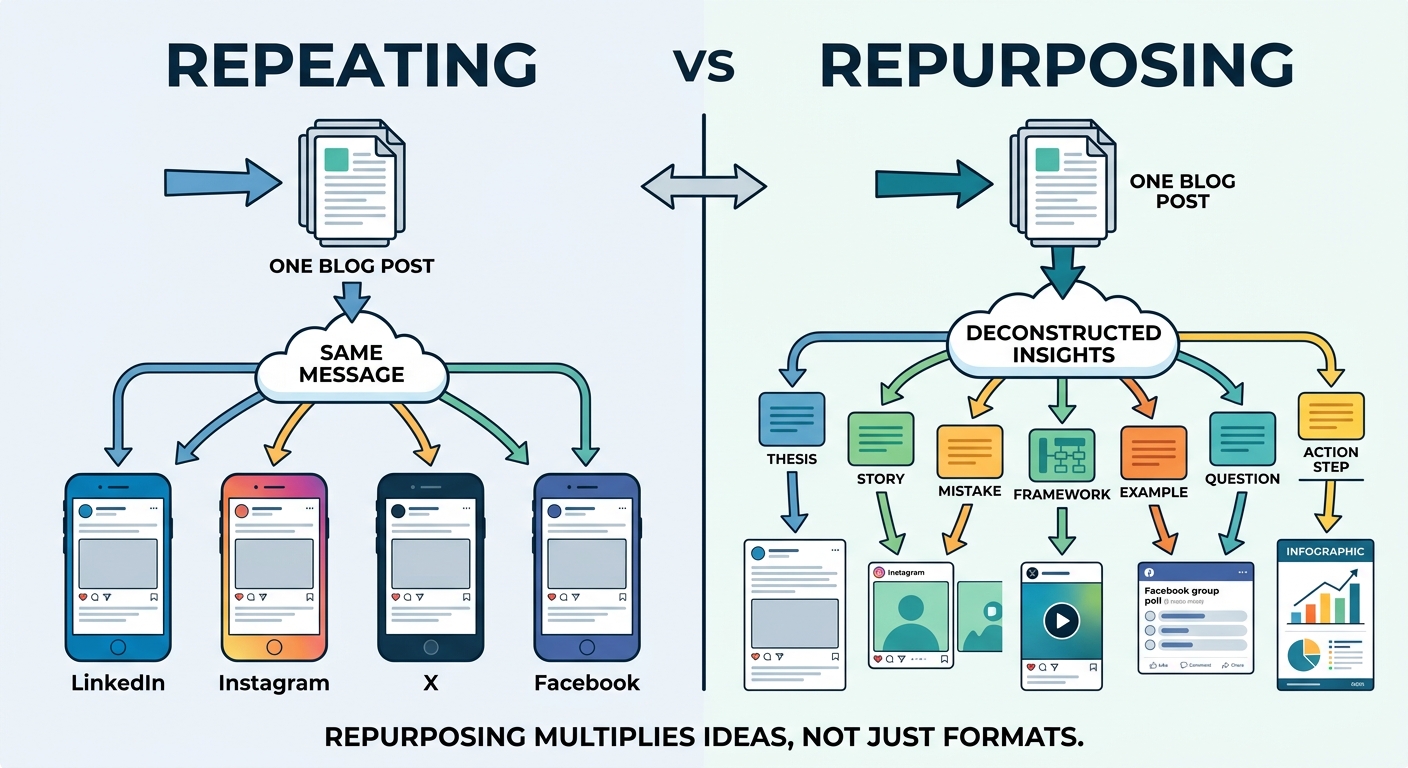
Repurposing Isn't Repeating
This is the mistake beginners make most often.
They write an article with one central idea, then publish:
- A LinkedIn post saying the same thing.
- An Instagram graphic saying the same thing.
- An X post saying the same thing.
- A short video saying the same thing.
Technically, the content has been repurposed. Strategically, very little has happened. You're still relying on one angle.
A strong blog article contains more than its headline. Inside it you might have:
- a central thesis,
- several supporting arguments,
- a useful framework,
- an example,
- a mistake readers make,
- a surprising observation,
- a statistic or piece of evidence,
- a process,
- an objection,
- and a practical next step.
Those are separate content opportunities. The goal isn't to say the same thing seven times. It's to take one substantial piece of thinking and find seven useful ways into it.
Step 1: Mine the Article Before You Create Anything New
Before opening Canva or asking AI for 20 social posts, go back to the article.
You're looking for what I call the idea inventory.
Think of the blog post as a mine. The finished article is what readers see on the surface. Your job now is to go back inside and extract the valuable pieces that can stand independently.
Start with these seven categories.
1. The core thesis
What is the single most important argument in the article?
For this article, it would be:
You don't need a completely new idea every time you publish on social media. You need to extract more value from your strongest existing ideas.
That's already a potential social post.
2. The strongest supporting point
Which idea makes the central argument believable? For example:
If you spend five hours developing an article and promote it once, your problem may not be content creation. It may be idea utilization.
That's another post. And notice that it doesn't simply repeat the headline. It introduces a different way of understanding the problem.
3. The mistake
Mistakes make excellent social content because readers can quickly compare the advice against their own behaviour. For example:
"The biggest repurposing mistake isn't failing to post enough. It's copying the same message onto every platform and calling it a content strategy."
Now you have a third angle.
4. The framework or process
If the article teaches steps, those steps can often become:
- A carousel.
- A thread.
- A short educational video.
- A checklist.
- A text post.
The process itself becomes an asset.
5. The example or story
Abstract advice becomes more memorable when people can see it happening. If your article contains a customer example, personal experience, hypothetical scenario or before-and-after comparison, extract it.
Stories often perform differently from instructional posts because they let you teach without starting with "Here are five tips..."
6. The contrarian or surprising idea
Look for the sentence that challenges what your audience normally assumes. In this case:
"Your content bottleneck may not be creation. It may be distribution."
That deserves its own post.
7. The action step
What is one useful thing someone could do today? For example:
"Open your best-performing article. Highlight its thesis, three supporting points, best example, biggest mistake and strongest action step. You probably just found your next seven social posts."
That's useful even without reading the full article. And that's important. Every repurposed asset should deliver some value independently.
The Idea Inventory
Before you start repurposing, your notes might look something like this:
| Source material | Extracted idea | Potential asset |
|---|---|---|
| Core thesis | Repurpose ideas, not words | LinkedIn post |
| Key insight | Creation may not be the bottleneck | Short video |
| Mistake | Copy-pasting across platforms | Contrarian post |
| Framework | Seven things to extract | Carousel |
| Example | Five-hour article promoted once | Story post |
| Question | Are you underusing your best ideas? | Audience discussion |
| Action step | Audit your strongest article | Checklist post |
Now you aren't staring at an empty social calendar. You're working from intellectual material you've already developed.
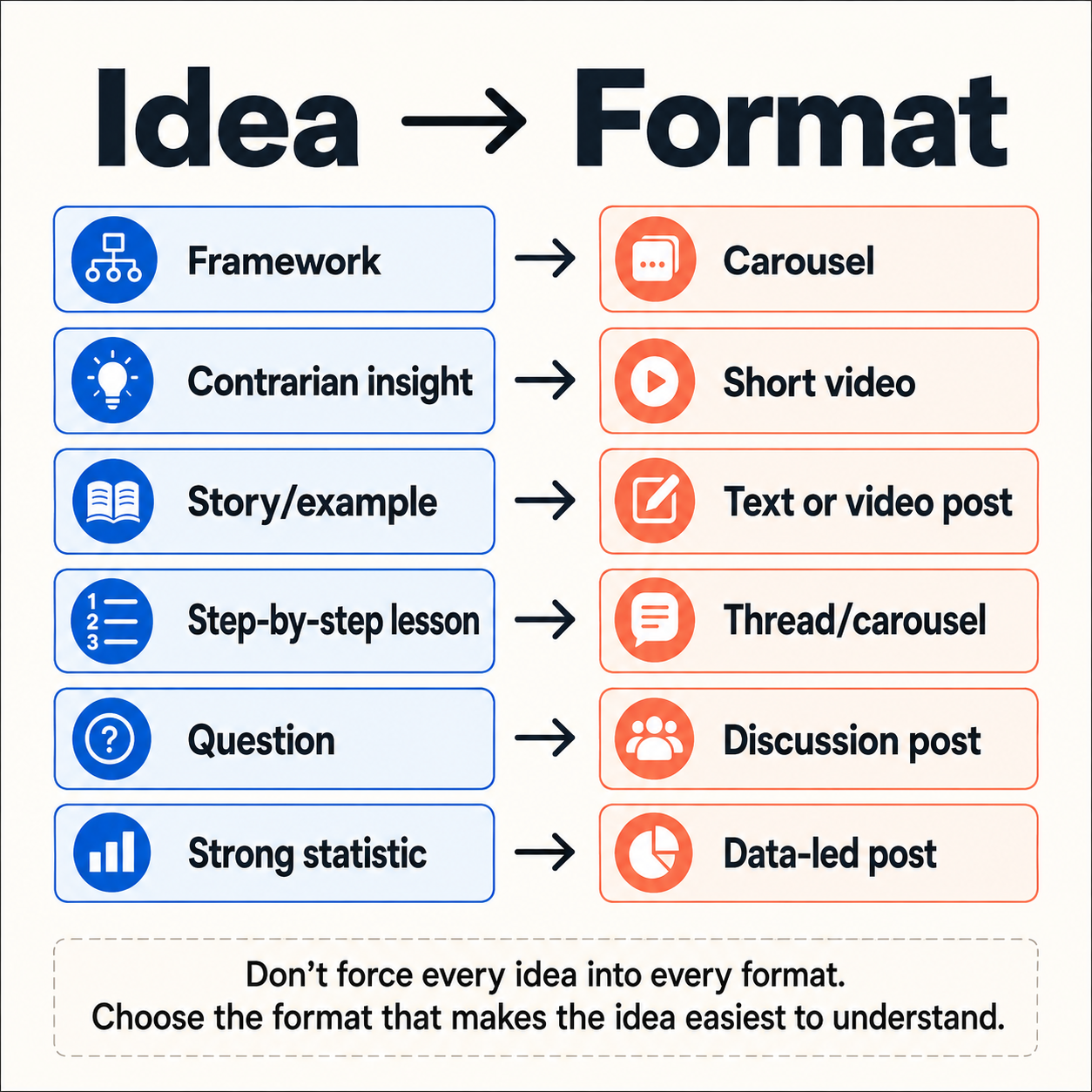
Step 2: Match the Idea to the Format
Once you've extracted the ideas, resist another common mistake: choosing the platform first.
People often think: "I need an Instagram post today. What can I say?"
Reverse it. Ask: "I have this strong idea. What's the best way to communicate it?"
A framework might work beautifully as a carousel because readers can move through the steps visually. A surprising claim might make a strong short video. A nuanced argument might deserve a LinkedIn text post. A collection of related observations could become a thread. A striking sentence might work as the opening of a discussion post—but only if you expand it with substance.
The idea comes first. The format serves the idea.
Step 3: Give Every Post Its Own Job
This is where repurposing starts becoming strategic.
Your seven social posts don't need seven completely different subjects. But they should have different jobs.
- One can create awareness.
- One can educate.
- One can challenge an assumption.
- One can demonstrate expertise.
- One can encourage discussion.
- One can send people to the original article.
- One can move commercially interested readers towards your offer.
Now you're building a distribution sequence rather than filling seven boxes on a calendar. Here's what that could look like.
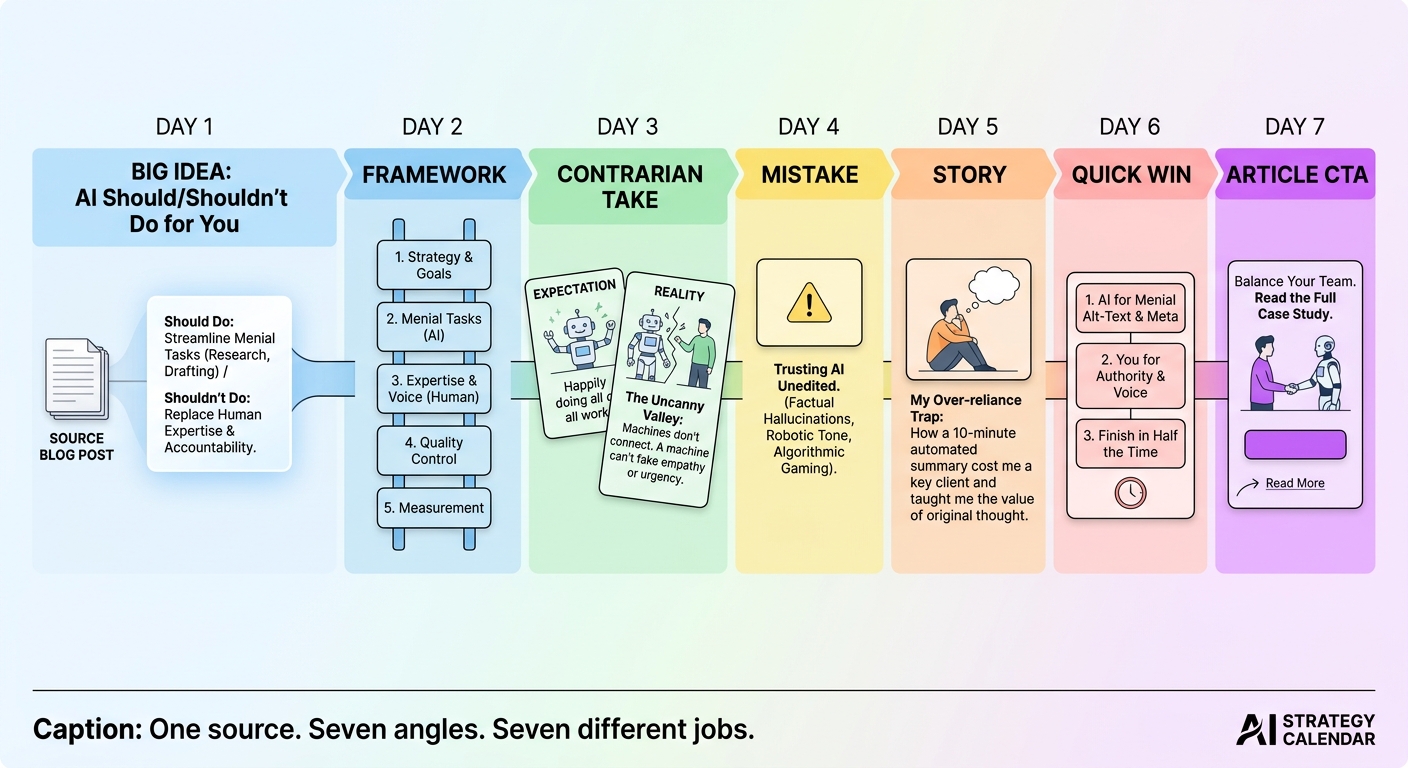
Day 1: Lead With the Big Idea
Start with the article's central argument. For example:
"You probably don't need more content ideas. You need to get more mileage from the good ideas you already have."
Then explain the problem. Most creators treat every publishing day as a demand for another original thought. That creates pressure to constantly invent.
A better system separates idea creation from content production. Develop fewer, stronger ideas. Then distribute those ideas through multiple useful angles and formats.
The objective of Day 1 is awareness. Introduce the worldview. Don't try to teach the entire article.
Day 2: Teach the Framework
Now take one practical section and turn it into educational content. For this article, that could be:
"Seven things to extract from every blog post before you move on."
- Core thesis
- Supporting insight
- Mistake
- Framework
- Example
- Contrarian idea
- Action step
This would make a natural carousel or step-by-step post. The objective is utility. Give readers something they can save and use.
Day 3: Challenge the Assumption
Now use the contrarian angle.
Hook:
"Your content problem might not be a lack of content."
Develop the argument: if you're already publishing useful articles but hardly distributing their ideas, producing more articles won't necessarily solve the underlying problem. You're pouring more water into a leaking bucket. Before increasing production, improve utilization.
Ask:
- How many useful assets did the last article create?
- How many audiences encountered its strongest idea?
- How many formats did you test?
- How long did you distribute it?
The objective is to change how the reader sees the problem.
Day 4: Show the Mistake
Mistake-based content is especially useful for beginners.
Hook:
"Copying your blog introduction into LinkedIn isn't repurposing."
Then explain why. Blog content and social content operate in different environments. The blog reader has already chosen to click. The social reader hasn't chosen you at all—you're interrupting their feed.
That means the opening, pacing and presentation often need rebuilding. Same expertise. Different packaging.
The objective is practical correction.
Day 5: Tell the Story
Take the abstract lesson and make it concrete.
Imagine a creator spends five hours producing a substantial article. They publish it. They share the link once. It receives modest attention. So next week, they spend another five hours creating another article.
After four weeks, they've invested 20 hours into four source assets, but each received only one real distribution push.
Now imagine they took the strongest article and extracted:
- Three LinkedIn posts.
- One carousel.
- Two short videos.
- One email.
- A discussion question.
- A follow-up article.
Suddenly the question changes from "How much content did we create?" to "How much useful distribution did each idea generate?"
The objective is understanding through example.
Day 6: Give Them a Quick Win
Your sixth post should be immediately actionable. Try something like:
"Do this 10-minute content audit:"
- Find your strongest blog post from the last six months.
- Highlight the central argument.
- Circle three useful supporting ideas.
- Find one example.
- Find one mistake.
- Pull out one actionable recommendation.
- Turn each into a separate post.
"Don't create anything new until you've checked what you've already underused."
The objective is action. The reader should be able to finish the post and immediately do something useful.
Day 7: Bridge to the Deeper Resource
Now send interested readers back to the source. But don't simply post: "ICYMI, here's my latest blog." Give them a reason to care. For example:
"Most content calendars have a hidden flaw. They tell you what to create. They rarely tell you how much value to extract from what you've already created.
I've broken down the system I use to turn one substantial article into a week of distinct social content—without copying and pasting the same message seven times.
If you're trying to publish consistently without becoming a full-time content factory, start here."
Then link to the article. The objective is traffic. The social post earns the click by teaching the reader why the article matters.
Your Seven-Day Repurposing Map
| Day | Angle | Suggested format | Primary job |
|---|---|---|---|
| Monday | Big idea | Text post | Awareness |
| Tuesday | Framework | Carousel | Education |
| Wednesday | Contrarian insight | Short video | Perspective shift |
| Thursday | Common mistake | Text post/thread | Correction |
| Friday | Example/story | Story-led post | Understanding |
| Saturday | Quick win | Checklist/video | Action |
| Sunday | Deeper resource | Teaser + article link | Traffic |
Notice what's happening. Seven posts. One source article. But not seven copies of the same post. Each asset enters the subject through a different door.
What AI Should—and Shouldn't—Do for You
This is where AI can dramatically compress the workload.
Once you've done the strategic work, AI can help you:
- Extract potential ideas from the article.
- Identify strong hooks.
- Find sections suitable for carousels.
- Turn a detailed explanation into a short-video structure.
- Generate alternative angles.
- Adapt an idea for different platforms.
- Condense a framework.
- Develop discussion questions.
- Create variations of a CTA.
But there's an important distinction.
Don't ask: "Turn this blog post into seven social posts." That's how you often end up with seven summaries of the same article.
Instead, give AI a strategic job. Ask it to identify the article's:
- Core thesis.
- Strongest insights.
- Contrarian ideas.
- Examples.
- Tactical lessons.
- Emotional tensions.
- Evidence.
- Reader objections.
- Commercial implications.
Then decide which ideas deserve to become standalone assets.
AI performs much better when you're asking it to help execute a content strategy rather than asking it to invent the strategy after the fact.
Don't Publish Everywhere Just Because You Can
Repurposing does not mean you suddenly need seven social platforms.
If your audience primarily uses LinkedIn and YouTube, build for LinkedIn and YouTube. If you're targeting visual creators, Instagram may deserve more attention. If your audience prefers newsletters, email might be more valuable than adding another social network.
Distribution should follow the audience. Not the availability of another "share" button.
For a beginner, two platforms used deliberately are usually more manageable than six platforms maintained badly.
Choose your primary channel. Choose one secondary channel if appropriate. Learn what works there. Then expand.
Don't Make Every Repurposed Post a Promotion
There's another trap.
Once marketers realize one article can create many social assets, they sometimes turn every asset into: "Read my blog."
That's not distribution. That's repeated advertising.
Most repurposed content should provide value where it is consumed. Teach the lesson. Tell the story. Explain the mistake. Give away the framework.
Then, when the deeper article genuinely adds something, invite the reader to continue. This builds more trust than constantly withholding the useful part behind a click.
The Simple Rule: Change the Angle, Not the Truth
Repurposing doesn't require inventing seven opinions. Your core position should remain consistent. What changes is the entry point.
Think about a diamond. It's one object. Turn it slightly and another surface catches the light.
Strong ideas work the same way. One argument can have:
- A beginner angle.
- A tactical angle.
- A contrarian angle.
- A story angle.
- A data angle.
- A mistake angle.
- A commercial angle.
You're not manufacturing more expertise. You're revealing more of the expertise already there.
How to Make This Repeatable
The real payoff comes when this stops being something you occasionally remember to do.
Add repurposing to the original content workflow.
Instead of:
Idea→
Write→
Publish→
Start again
Build:
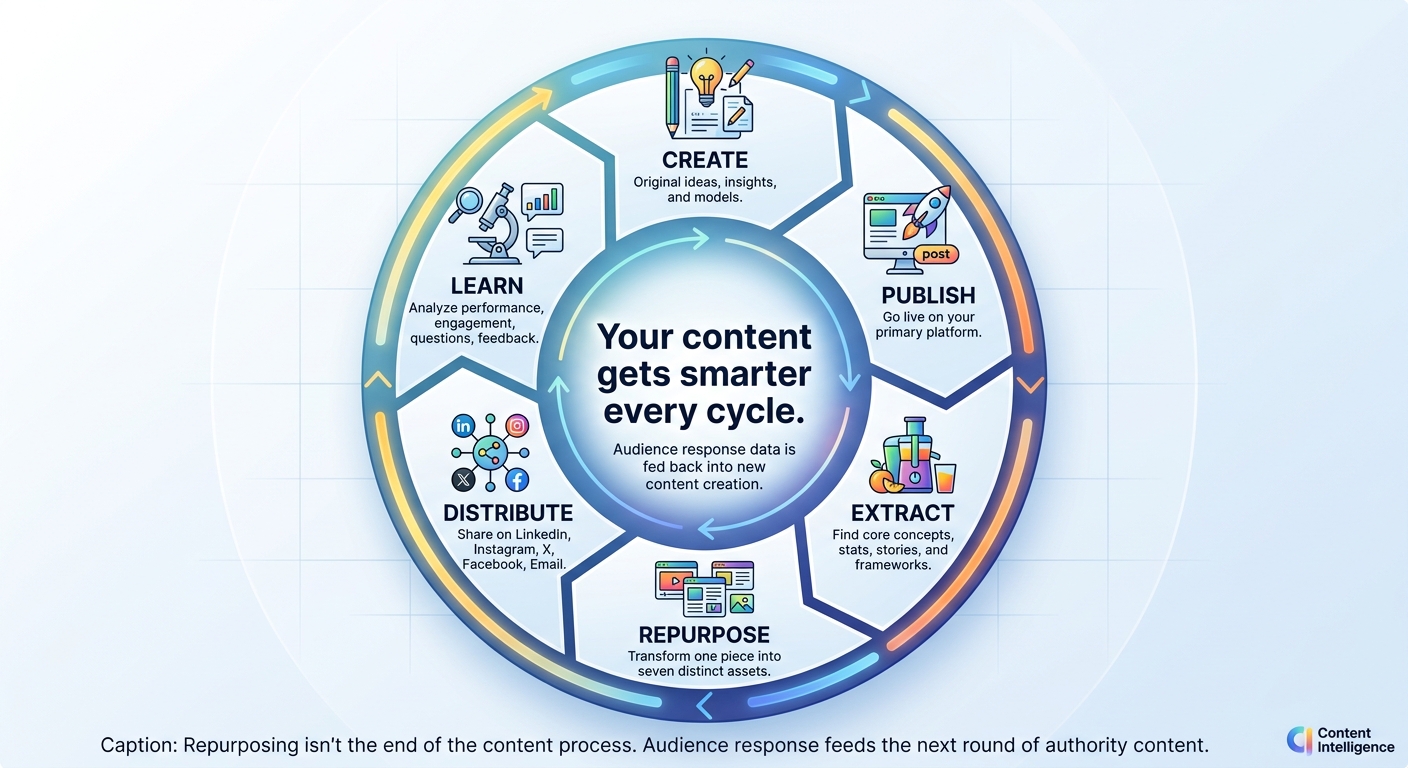
Idea→
Research→
Write→
Publish→
Extract→
Repurpose→
Distribute→
Learn
Then feed what you learn back into the next article.
If one social angle generates unusually strong discussion, that might deserve its own article. If readers repeatedly ask the same question, that question might become a cluster topic. If a short video exposes a misunderstanding, your pillar content may need updating.
Distribution doesn't merely promote content. It gives you information about what your audience cares about. That's how a content system gets smarter.
Start With One Article
You don't need an enormous content library to use this system.
Start with one article. Preferably one that already contains something worth distributing.
- Extract the idea inventory.
- Choose seven angles.
- Match those angles to appropriate formats.
- Give every asset a specific job.
- Publish them over the following week.
- Watch what happens.
Then repeat the process with the ideas that deserve another cycle.
The objective isn't to become a machine that publishes more and more content. It's to stop wasting the value of content you've already worked hard to create.
One strong idea should be allowed to travel.
Turn Your Best Ideas Into a Content Engine
Everything in this article can be done manually. And if you're just starting, I recommend understanding the process before trying to automate all of it.
But once you have strong source content, manually extracting every insight, developing multiple angles, adapting each one to different platforms, writing hooks, creating CTAs and planning distribution can become time-consuming.
That's where Content Empire Builder fits.
You bring the expertise. Content Empire Builder helps you build the system around it.
Instead of asking AI to simply "make some social posts," use Content Empire Builder to help turn substantial source content into strategically different assets built around the ideas, audience and commercial objective.
The goal isn't more AI-generated noise. It's getting more value from your best thinking.
You already did the hard part: developing an idea worth sharing. Now make it travel.
Use Content Empire Builder to turn your next authority article into a content engine—and turn one strong piece of thinking into a week of opportunities to be discovered, remembered and trusted.