Why Most “Make Money Online” Advice Doesn’t Work for Beginners
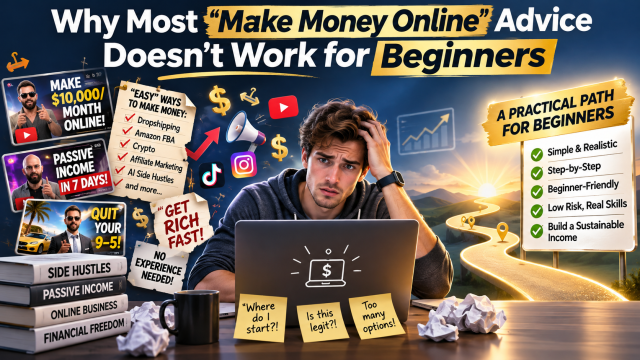
Three years ago I spent $47 on an ebook that told me to “just start dropshipping.” I built a store in a weekend, picked products based on a YouTube video, and waited. Four months and about $600 in ad spend later, I’d made two sales and lost most of my evenings to a Shopify dashboard that mocked me every time I opened it. The advice wasn’t wrong, exactly. It just wasn’t written for someone like me: a person with a full-time job, two hours a night if I was lucky, and no audience, no capital cushion, and no idea what I didn’t know.
That gap between the advice and the person reading it is the whole problem. Most make money online advice that works for the person giving it was never built for the person starting from zero.
Key Takeaways
- Most popular advice is written by people who already have an audience, capital, or years of skill behind them, so it skips the steps a true beginner actually needs.
- Generic advice like “just start a YouTube channel” or “just start dropshipping” fails beginners because it hides the 80% of the work that happens before any money shows up.
- Limited time is not a disadvantage to design around once, it’s a constraint that should shape which business model you pick in the first place.
- Make money online advice that works for beginners looks less like a hustle and more like a system you can run in short, repeatable sessions using tools that didn’t exist five years ago.
The advice isn’t lying, it’s just not talking to you
Here’s what nobody tells you when you watch a video titled “How I Made $10,000 Last Month Selling Printables.” The person in that video usually has three or four years of trial and error behind them that never made the thumbnail. They tried seven niches before one worked. They had an email list of 2,000 people from a previous project. They knew how to use Canva, basic copywriting, and had already failed at two other business models, which taught them things they now present as a clean, linear path.
You’re watching the highlight reel of someone’s year five and trying to apply it to your day one. That’s not a minor mismatch. It’s the entire reason so much advice fails beginners specifically.
I didn’t understand this back when I built that dropshipping store. I thought the gap between me and the guy in the video was effort. It wasn’t. It was that he’d already built the skills, audience, and intuition that made his version of “just start” actually mean something. For me, “just start” meant starting from absolute zero with none of that scaffolding, and the advice gave me zero scaffolding to build it.
The four-hour-a-week problem nobody designs for
Most make money online content assumes you have flexible time. It assumes you can post three times a day, respond to comments within the hour, batch-create content on a Tuesday afternoon, or hop on sales calls whenever a lead comes in. If you have a demanding job, kids, or both, none of that is true for you.
When I was still working full-time and trying to build something on the side, my actual available time was something like six hours a week, usually broken into 45-minute chunks after my daughter went to bed. Almost everything I tried assumed I had three or four uninterrupted hours at a stretch. Content calendars built for people who could batch twenty posts in a sitting. Client acquisition strategies that needed same-day responsiveness. Even the “easy” stuff, like managing a print-on-demand store, needed more fiddly, interruptible attention than my schedule allowed.
This is the part most gurus skip entirely: the business model you choose has to match your actual time shape, not just your goals. A strategy that needs four hours of uninterrupted focus is a bad strategy for someone who has forty-five minutes at 9pm, even if the strategy itself is sound in theory.
Generic advice hides the boring 80%
“Start a YouTube channel.” “Build an email list.” “Just start dropshipping.” “Sell a digital product.” Every one of these is technically true and practically useless on its own, because each one hides an enormous amount of unglamorous work that nobody wants to put in a thumbnail.
Take “start a YouTube channel.” That sentence skips over: figuring out what to actually talk about that people search for, learning basic video editing, understanding retention curves, writing a hook that keeps someone watching past the first eight seconds, building a thumbnail that doesn’t look like it was made by a beginner, and doing all of that consistently for months before the algorithm starts sending you any meaningful traffic. The advice isn’t wrong. It’s just a destination with no map.
I spent most of a year on a niche blog doing something similar. I had good advice in the broad sense, write consistently, pick a niche, build backlinks, but no real system for turning three hours a week into forward progress. I’d write a post, publish it, check analytics obsessively, get discouraged by the lack of traffic, and lose two weeks of momentum feeling like I was bad at this. I wasn’t bad at it. I didn’t have a system that accounted for how slow and compounding this kind of work actually is, especially when you can only put in a few hours a week.
This is the difference between advice and a system. Advice tells you what to do. A system tells you what to do this Tuesday at 8pm with the 40 minutes you actually have, and what that session connects to next week.
Why “just be consistent” isn’t a strategy
Consistency gets thrown around like it’s a tactic. It’s not. It’s a result of having a workload small enough and clear enough that you can actually sustain it. Telling a beginner to “just be consistent” without giving them a task list sized to their actual week is like telling someone to “just run a marathon” without a training plan.
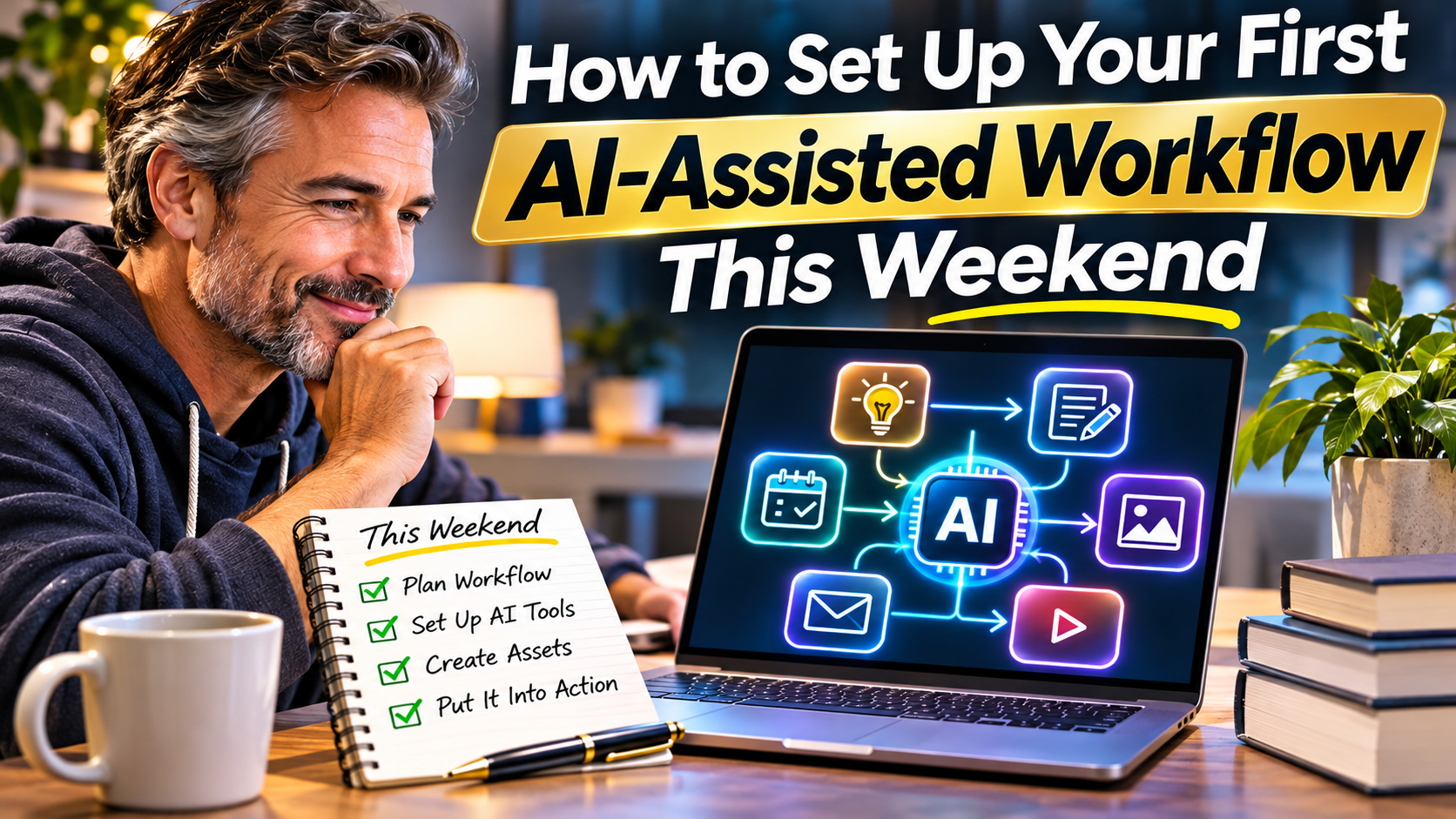
When I finally got traction, it wasn’t because I became more disciplined. I’m not more disciplined now than I was three years ago. What changed is that I stopped trying to do everything manually and started using AI tools to compress the parts of the work that used to eat my limited hours: outlining content, drafting first passes of copy, researching keyword angles, generating product description variations, even structuring a week’s worth of social posts in one sitting instead of staring at a blank screen seven separate times.
That’s not a shortcut around doing the work. The work still has to get done, and you still have to make real decisions, edit what the tools give you, and understand your market well enough to know what’s good and what’s garbage. But it collapses four hours of grinding into forty-five minutes of focused editing, which matters enormously when forty-five minutes is literally what you have.
The capital and risk mismatch
A lot of the loudest advice assumes you can absorb losses that a beginner with a day job and a mortgage genuinely cannot. Spend $2,000 testing ad creative. Buy inventory upfront for a product you haven’t validated. Hire a virtual assistant before you have revenue to pay them. For someone with disposable capital and an existing income stream, these are reasonable bets. For someone trying to build $500 a month in extra income without jeopardizing their household budget, they’re reckless.
My $47 ebook and $600 in ad spend wasn’t a huge amount of money in the abstract. But it was real money for me at the time, and losing it on a strategy I didn’t fully understand set me back emotionally more than financially. I got gun-shy. I didn’t try anything new for almost eight months afterward because I’d internalized the lesson as “I’m bad at this” instead of “that particular model required a risk tolerance and capital base I didn’t have.”
The honest version of make money online advice that works for a true beginner starts with low or no upfront capital, lets you validate an idea before you spend meaningfully on it, and treats early losses as information rather than inevitabilities you need a bigger budget to survive.
Skills advice versus system advice
There’s a particular kind of advice that tells you to “learn copywriting” or “get good at video editing” as though that’s a weekend project. These are real, valuable skills, and I’m not knocking them. But telling a beginner with six hours a week to go become a skilled copywriter before they can make any money is functionally telling them to wait a year or two before starting.
What actually worked for me was closer to this: use AI-assisted tools to get a competent first draft fast, then spend my limited hours on the judgment calls that actually need a human, does this sound like me, does this actually solve the customer’s problem, is this the right offer for this audience. I didn’t need to become a professional copywriter. I needed a system that let me produce decent copy in twenty minutes instead of two hours, so I could spend my remaining time on the parts of the business that genuinely needed my brain: picking the right offer, talking to actual customers, deciding what to build next.
This is a meaningful shift from the old advice, which assumed you had to build deep expertise in five or six different skills (copywriting, design, SEO, basic video, email marketing, customer service) before you could run a one-person operation. AI-assisted systems don’t replace judgment. They replace the slow, repetitive execution that used to require either deep skill or a lot of hours, neither of which most beginners have.
Why the content creation, eCommerce, and services paths all get the same advice (and shouldn’t)
Walk through any three popular beginner guides and you’ll notice they recommend roughly the same five steps regardless of whether you’re starting a content channel, an online store, or a freelance service. Pick a niche. Build an audience. Create consistently. Monetize. Scale. This is true in the way “eat food to live” is true. It doesn’t tell you anything about what to actually do on a Tuesday.
A services-based side hustle, say freelance writing, design, or virtual assistance, has a completely different shape from an eCommerce store. Services can generate income in your first month because you’re trading time for money directly, but they don’t scale without either raising your rates or hiring help. eCommerce has upfront product and testing costs but can scale without you personally doing more hours once it’s working. Content creation is the slowest to pay off (often six months to a year of unpaid effort before meaningful traffic or an audience exists) but compounds the most once it does, because the content keeps working after you’ve stopped actively producing it.
Generic advice flattens these into the same five-step funnel, which is actively misleading. If you need income in 60 days because your situation genuinely requires it, content creation is the wrong starting point no matter how much you like the idea of it. If you only have four or five hours a week and no capital, launching an inventory-based eCommerce store before you’ve validated demand is backwards. Matching the model to your actual constraints, time, money, and how fast you need results, matters more than picking the “best” business model in the abstract, because there isn’t one. There’s only the one that fits your situation.
What make money online advice that works actually looks like
After the dropshipping failure, the slow blog, and a handful of other attempts I won’t bore you with, the pattern that finally worked had a few things in common that I think are worth naming plainly, because they’re the opposite of what most popular advice offers.
It started small enough to fit inside my actual week. Not a five-hour-a-day content machine, a system built around 45 to 90 minute sessions, two or three times a week, that still moved something forward each time.
It had a validation step before any real spend. Before I put money into inventory, ads, or tools, I tested whether anyone actually wanted the thing, usually with something as simple as a landing page, a small organic post, or a direct conversation with a handful of potential customers.
It used AI tools to handle the repetitive execution, drafting, outlining, variations, research, so my limited hours went toward decisions and judgment instead of typing. This is the single biggest difference between what worked for me and everything I tried in the years before it existed as an option.
And it treated the first few months as data collection, not a verdict on whether I was cut out for this. The blog that eventually gained traction looked like a failure for the first four months by any reasonable measure. The difference is I had a system telling me what “on track” looked like at month two versus a gut feeling that I should quit because nothing was happening yet.
The mindset shift that actually mattered
I want to be straight with you about something, because most people in this space won’t be: none of this is about finding the one trick that makes it easy. The dropshipping store failed partly because of bad advice and partly because I genuinely believed there was a version of this that didn’t require sustained, somewhat uncomfortable effort over months. There isn’t. What changed wasn’t that the effort disappeared. It’s that the effort finally went somewhere, because the system I was using matched my actual constraints instead of fighting them.
If you’ve tried something before and it didn’t work, that’s not strong evidence you’re bad at this. It’s reasonably strong evidence that the advice you were following wasn’t built for someone in your situation. Those are very different conclusions, and only one of them is useful going forward.
Where to go from here
If any of this sounds familiar, you’ve already done the hardest part, which is noticing that the advice itself might be the problem rather than you. That’s a more useful starting point than most people ever reach, because it stops you from repeating the same mismatch with a slightly different business model next year.
The next useful step isn’t picking a new “best” side hustle for 2024. It’s getting honest about your actual weekly hours, your actual risk tolerance, and how fast you genuinely need results, and then choosing a model and a system that fits those numbers rather than someone else’s highlight reel.
Frequently Asked Questions
Why do most make money online strategies fail for beginners specifically?
Most strategies are built and shared by people who already have an audience, capital, or years of relevant skill, so the advice skips the groundwork a true beginner actually needs. It assumes flexible time, spare money to test with, and existing skills like copywriting or editing, none of which a beginner typically has yet.
How much time do I realistically need to start a side hustle online?
It depends more on the model than most advice admits. Service-based work can start generating income with just a few hours a week since you’re trading time directly, while content creation usually needs several months of consistent effort before it produces meaningful results, even at low weekly hours.
Is it possible to start making money online with no money to invest?
Yes, particularly with service-based work or content creation, both of which can start with little more than your time and free or low-cost tools. eCommerce is the model that typically needs some upfront capital for inventory or testing, which is worth knowing before you pick a starting point.
What makes AI-assisted systems different from the old “make money online” playbooks?
Older playbooks assumed you’d personally do every repetitive task, writing, researching, designing, which eats the limited hours a beginner actually has. AI-assisted systems handle the repetitive execution so your time goes toward the judgment calls that actually need a human, which is what makes a few hours a week go much further than it used to.
If you’re tired of advice that assumes you have more time, money, or experience than you actually do, and you want a path that starts from where you genuinely are, you can find out more about how this looks in practice.