
Digital Products vs Freelancing vs Affiliate Marketing: Which Path Fits Your Hours

You have maybe five hours a week. You’ve heard you can build income online, but you’re staring at three completely different paths and no clear reason to pick one over the others. The choice matters because each one demands something different from you at the start, and picking wrong costs you months.
The truth is that all three can work. But they don’t work the same way, and they don’t work for the same person in the same season of life.
Key Takeaways
- Freelancing rewards you fastest if you already have a skill and can sell it immediately; digital products take longer to revenue but scale without your direct time once built.
- Affiliate marketing needs either an existing audience or months of content-building before you earn meaningful money, making it the slowest start of the three.
- Your choice depends on your current assets: spare time, existing skill, existing audience, and how quickly you need the money.
- Most people succeed by starting with whichever path matches their immediate reality, not by guessing which one sounds most lucrative.
The Three Paths Are Not Equally Slow
A freelancer I knew, Sarah, needed an extra £300 a month by month three. She’d spent ten years in corporate communications. She didn’t want to build a product. She didn’t want to wait for affiliate commissions. She needed the money soon.
Within two weeks, she had her first paying client—a small business that needed social media copy written. Within six weeks, she had three regular clients and hit her target.
That wouldn’t have happened if she’d chosen to build a digital course. A course would have taken her three months just to map out and record, and then another two months of promoting before seeing her first real sale. Affiliate marketing would have been even slower. She’d need an audience first, either built organically over months or bought through advertising she couldn’t afford yet.
Freelancing is the fastest path to money if you’re starting from a skill you already have. The barrier is not building something—it’s convincing someone to pay you for what you can already do.
This matters because it shapes everything else. If you need money in the next eight weeks, freelancing is the only realistic option. If you can wait six months, the other paths open up.
Why Digital Products Look Easier Than They Are
Digital products are seductive because the story sounds effortless: you build something once, sell it many times, earn while you sleep. That part is true. But it misses the hard part.
The hard part is that nobody knows about your product. Building it takes 12 to 16 weeks if you’re moving fast. Then you need to reach people. If you don’t already have an audience, you’re starting from zero visibility. You either spend money on ads—money you might not have yet—or you spend time building an audience first. That’s another 10 to 20 weeks of consistent content before you have enough attention to launch to.
A friend, Marcus, decided to build a Notion template for small business owners. He spent eight weeks designing it. It was good—clean, practical, something he’d use himself. He launched it to his email list of 200 people. He made £140. He’d expected maybe £800.
Why? Because 200 people is not enough to generate significant revenue from a £20 product. He needed to reach 1,000 or 2,000 people who actually cared about Notion templates. That meant he needed to have built an audience first, or have access to existing channels where those people were already gathered.
Digital products work. They scale. But they’re not faster than freelancing at the beginning. They’re slower to revenue, and the revenue is smaller, until your audience is big enough to make volume work in your favor.

This is worth saying plainly: if your goal is to earn £300 this month, digital products are the wrong choice. If your goal is to earn £3,000 a month six months from now with minimal time input, digital products become interesting—but only if you’re willing to front-load the audience-building work.
Affiliate Marketing Needs What You Might Not Have
Affiliate marketing is the third option, and it’s the one people choose when they don’t understand what it actually requires. The pitch is simple: promote other people’s products, earn commission. You don’t build anything. You don’t sell anything yourself. You just point people somewhere and take a cut.
But affiliate marketing depends entirely on having people to point somewhere. Without an audience, you have no one to direct to the product. Without traffic, you have no conversions. Without conversions, you have no commissions.
Where do you get the audience? Same place as digital products: you build it slowly or you pay for it quickly. You build it by creating content—blog posts, videos, social media, emails—that attracts people interested in what you’re recommending. This takes months. Three to six months is realistic before you have enough traffic to generate meaningful affiliate income.
Or you pay for ads. Facebook ads, Google ads, affiliate networks with built-in ad platforms. You spend money to drive traffic to your affiliate links. You earn commission on conversions. If your cost-per-click is higher than your commission-per-sale, you lose money. Most beginners lose money this way.
I tested affiliate marketing three years ago. I had a small blog—about 1,200 monthly visitors. I found a software tool I genuinely used and believed in, and I became an affiliate. I wrote a review. I embedded my affiliate link. Over three months, I made £47 in commission from 1,200 visitors. The math was brutal.
To make real money with affiliate marketing—say, £500 a month—I would have needed either 15,000 monthly visitors (building that took me years) or a paid ads budget (which requires capital). Most people starting from zero have neither.
Affiliate marketing isn’t a bad choice. It’s a bad choice if you think it’s faster than the other options or if you’re hoping to avoid building an audience or spending money. You do one or the other. There’s no third way.
Match Your Choice to Your Current Situation
This is where most people get stuck. They ask which path is best, as if there’s an objective answer. There isn’t. The best path is the one that matches what you have right now.
You should start with freelancing if:
- You have a skill that others will pay for and that you can describe clearly to a potential client.
- You need money in the next two to three months.
- You have a professional network or can articulate your value in a portfolio or testimonial.
- You don’t mind trading your time for money (at least at first).
Freelancing is the path of immediate revenue. You’re not building anything. You’re selling what you can do. The barrier is sales and confidence, not creation.
You should start with digital products if:
- You already have an audience—an email list, a social following, a podcast, a blog with consistent traffic.
- You can wait four to six months before seeing meaningful revenue.
- You have a clear idea of a problem your audience has that you can solve with a product.
- You want income that doesn’t scale directly with your time.
Digital products are the path of leverage. You’re building something once that can be sold many times. The barrier is visibility, not creation quality.
You should start with affiliate marketing if:
- You already have an audience or a clear, low-cost way to build one.
- You’re comfortable with longer timelines—eight to twelve months before real money.
- You genuinely use and believe in products you could recommend.
- You have either a content skill (writing, video, social) or a budget for ads.
Affiliate marketing is the path of leverage without creation. You’re not building a product; you’re directing traffic. The barrier is audience and trust.
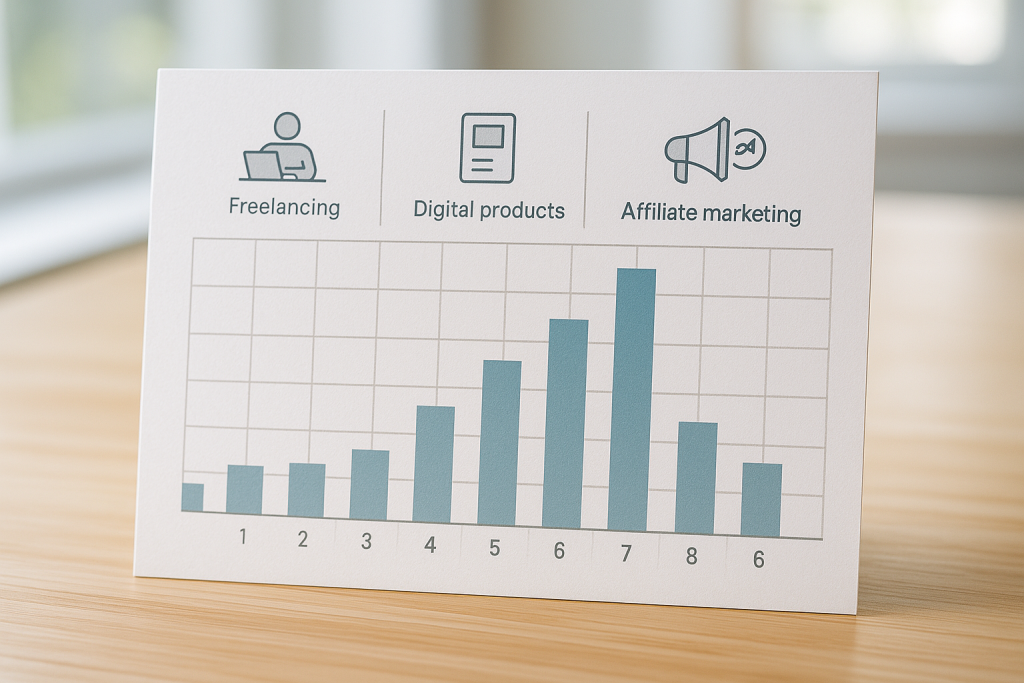
The Sequencing Question: Can You Do More Than One?
Yes. Most people who build sustainable income online do end up using more than one path. But the order matters.
A common sequence is: start with freelancing, use the money and credibility to build an audience, then launch a digital product or affiliate work that leverages that audience.
James, a designer, spent his first six months taking freelance client work. It wasn’t glamorous. It paid the bills. While he was doing client work, he documented what he was learning—the mistakes he’d made, the tools he was using, the shortcuts he’d discovered. He shared these insights on LinkedIn, publishing every Friday.
After 18 months, he had built an audience of about 8,000 engaged followers. That audience was there because he’d proven he actually understood design, because he shared real experience, not hype. He then created a digital product—a template bundle for design briefs. He sold it to his audience. First month: £4,200. The audience did the work.
The sequence matters. He didn’t start by building the template and hoping people would buy it. He started with freelancing—the fastest path to revenue and credibility—and used that credibility as a foundation for the product.
Another valid sequence: start with content that builds toward affiliate marketing or products. Write or create consistently for two to three months. Build a small audience. Then introduce freelance services or a product once you have some credibility and visibility. This is slower to first revenue but often faster to recurring revenue.
What doesn’t work: doing all three at once when you have five hours a week. You’ll spin. You’ll look for the secret path instead of walking one path with intention. Pick one. Walk it for a defined period—12 weeks, 16 weeks, whatever your timeline allows. Then assess. Did it work? Double down. Did it not work? Switch.
The Speed-Money-Effort Triangle
Every path has a trade-off. You’re balancing three things: how fast you want to earn, how much you want to earn, and how much effort you’re willing to invest upfront.
Freelancing: Fast money, moderate total earnings (capped by your time), moderate upfront effort (just selling). Time investment: ongoing and proportional to income.
Digital products: Slow initial money, potentially high earnings (not capped by time once built), high upfront effort (building and promoting). Time investment: front-loaded, then drops dramatically.
Affiliate marketing: Slow initial money, moderate to high potential earnings, moderate upfront effort (building audience and trust). Time investment: ongoing until audience is large, then more flexible.
This triangle tells you something important: there’s no free lunch. You can’t have fast money, high earnings, and low effort all at once. Pick which two matter most to you.
If fast money is your priority: freelance.
If low ongoing time commitment is your priority: build a product or audience you can leverage.
If maximum earnings potential is your priority: you need an audience first, then either a product or affiliate work to leverage it.

The Missing Piece: Your Actual Situation
You’ve heard all three paths described now. You know the trade-offs. But choosing requires you to be honest about one thing: where are you actually starting?
This means asking yourself:
- What skill do I have right now that someone would pay for?
- Do I already have an audience in any form—email, social, blog traffic, professional network?
- How many hours do I realistically have per week, and for how many weeks can I sustain this?
- When do I need the money? This month? Three months? Six months?
- What is the total amount I’m trying to earn? £200? £2,000? £5,000?
The answers to these five questions will tell you which path fits. Not which path is best in theory. Which path is possible for you now.
Someone with an existing LinkedIn following, three months, and a goal of £1,500 should probably build a small digital product. Someone with 15 years of IT experience, four weeks, and a goal of £600 should freelance. Someone with zero audience and 18 months should probably start with content and affiliate work, or with freelancing, because both paths are open.
This sounds obvious when it’s written down. But in reality, most people choose based on what sounds most appealing or what they heard on a podcast, not based on their actual situation. They ignore their own assets and constraints.
Frequently Asked Questions
Can I start all three at the same time?
Not if you have limited hours. You’ll start all three and finish none. Pick one path for 12 to 16 weeks. Master it or prove it doesn’t work for you. Then add a second path. Most people succeed by being deliberate about sequencing, not by juggling three things at once.
Which path has the highest income ceiling?
Digital products and affiliate marketing both have higher ceilings than freelancing because they’re not directly limited by your available hours. But reaching that ceiling requires audience and trust, which take time. Freelancing’s ceiling is your hourly rate times available hours, but you can hit it immediately.
If I start with freelancing, can I transition to products later?
Yes. Freelancing gives you credibility and often positions you as someone who understands the problem you solve. That credibility is valuable when you launch a product. Many successful product creators started as service providers first.
What if I have no audience and no specific skill—where do I start?
You likely have a skill you’re underestimating. Start by defining what you’ve done professionally, what you’ve learned, what problems you’ve solved. That’s your freelancing entry point. Alternatively, start building content and audience first, with the intention of leveraging it later for products or affiliate income. This path is slower but doesn’t require you to have something to sell immediately.
The Path Forward
You don’t need to predict which path is best. You need to pick the one that matches where you are right now, commit to it for a real time period, and measure what happens. Most people overthink this part. They want certainty before they start. The certainty comes from doing, not from reading another article about the options.
If you’re ready to move past the choice and into the actual work, find out more.
